
Pre-registration for:
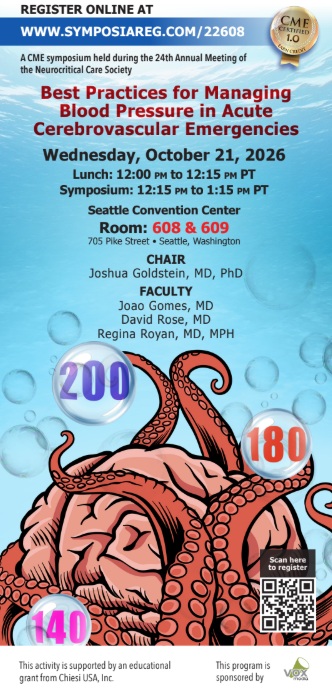
Best Practices for Managing Blood Pressure in Acute Cerebrovascular Emergencies
Wednesday October 21, 2026
Lunch: 12:00 pm to 12:15 pm PT
Symposium: 12:15 pm to 1:15 pm PT
Seattle Convention Center
Room: 608 & 609
705 Pike Street
Seattle, Washington
Program Overview:
Acute blood pressure (BP) management is neurologic patients is paramount.
Different cerebrovascular emergencies dictate various BP goals. Ischemic strokes
account for >80% of all strokes in the United States and >60% of all strokes
globally; acute ischemic stroke (AIS) is the second leading cause of death
worldwide. There are distinct BP management strategies to be applied
prehospital, after diagnosis but before reperfusion treatment, after intravenous
(IV) thrombolysis, and after endovascular thrombectomy. Neurocritical care
clinicians must be aware of the latest recommendations, and supportive
clinical trial evidence, described in the 2026 American Heart Association
(AHA)/American Stroke Association (ASA) AIS guideline. Acute spontaneous
(nontraumatic) intracerebral hemorrhage (ICH) causes one-third of strokes and
half the deaths and disability due to stroke worldwide. AHA/ASA spontaneous
ICH guidelines indicate that in patients with spontaneous ICH requiring acute
BP lowering, careful titration to ensure continuous smooth and sustained
control of BP, avoiding peaks and large variability in SBP, can be beneficial for
improving functional outcome. The acute management of ICH is critically timesensitive;
current AHA/ASA guidelines state that in patients in whom acute BP
lowering is considered, initiating treatment within 2 hours of ICH onset and
reaching target within 1 hour can be beneficial to reduce the risk of hematoma
and improve functional outcome. Increased BP variability in the acute phases
of cerebrovascular emergences, such as AIS and ICH, has been shown to result
in worsened outcomes. Although several studies have reported this association,
no consensus exists for specific BP variability targets or a consistent, unified
definition of BP variability in AIS or ICH. A consortia has recently developed
a working consensus on defining BP variability, identifying interventions to
mitigate negative outcomes from increased BP variability, and laying the
groundwork for BP variability concepts in the future. In this symposium, experts
will describe best practices for BP management in patients experiencing acute
cerebrovascular emergencies and emerging concepts through state-of-the-art
lectures and a “real-world” case presentation.
Educational Objectives:
Upon completion of this activity, participants should be able to:
- Identify BP recommendations and supportive evidence from the AHA/ASA Acute Ischemic Stroke (AIS) 2026 guideline
- Explain findings from landmark BP trials in patients with intracerebral hemorrhage (ICH) and recently published clinical insights
- Recognize the importance of reducing BP variability in AIS and ICH patients
- Describe the profiles of, and clinical evidence for antihypertensive agents used for the management of acute cerebrovascular emergencies