
Pre-registration for:
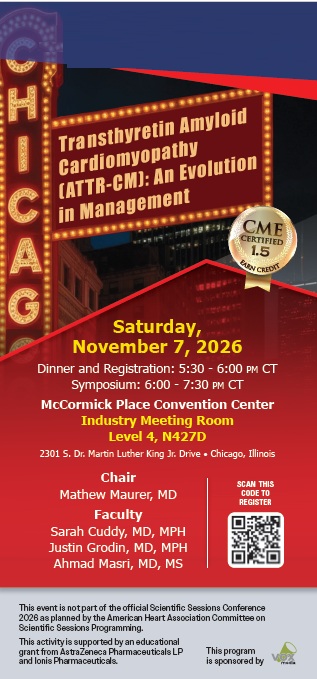
Transthyretin Amyloid Cardiomyopathy (ATTR-CM): An Evolution in Management
Saturday, November 7, 2026
Dinner & Registration: 5:30 pm to 6:00 pm CT
Symposium: 6:00 pm to 7 pm CT
McCormick Place Convention Center
2301 S. Dr. Martin Luther King Jr. Drive
Chicago, Illinois
Program Overview:
Transthyretin amyloidosis (ATTR) is a progressive, multisystemic, life-threatening disease characterized by deposits of amyloid fibrils in the peripheral nerves, heart, and other tissues and organs, resulting in polyneuropathy (PN), cardiomyopathy (CM), or a mix of both neurologic and cardiac manifestations. ATTR amyloidosis may be caused by one of over 130 pathogenic mutations that destabilize the TTR protein (hereditary or variant ATTR amyloidosis, represented as either hATTR or ATTRv) or the accumulation of non-mutated TTR protein (wild-type ATTR amyloidosis, or ATTRwt). The phenotypic presentation of ATTRv amyloidosis is clinically heterogeneous and can be predominantly neurologic, predominantly cardiac, or mixed phenotype, depending on the particular TTR variant and other factors. ATTRwt amyloidosis is the most common type of ATTR amyloidosis and most often presents as CM. Diagnosing ATTR-CM can be difficult due to low disease awareness, indeterminate family history, and the heterogeneity of clinical presentation that can overlap with more common diseases. Both ATTRv-CM and ATTRwt- CM are associated with markedly poor quality of life at the time of diagnosis and progressive deterioration when untreated, with patients frequently being hospitalized. Therefore, accurate and prompt diagnosis and treatment are key to improving clinical outcomes in patients with ATTR-CM. Crucially, the emergence of multiple disease-modifying therapies has transformed the therapeutic landscape, offering mortality and morbidity benefits that were previously unavailable.
In this symposium, ATTR experts will describe strategies for improving recognition of clinical clues for ATTR-CM and for making an earlier and accurate diagnosis. Evidence with disease-modifying therapies for ATTRCM will be presented including interpretations of recently completed clinical trials. Most effective use of HF medications in ATTR-CM patients will also be discussed. Two cases with panel discussions will be presented, 1) avoiding pitfalls and explaining best practices to overcome management challenges, and 2) successfully addressing the complexities of diagnosing
hereditary ATTR-CM and recognizing the importance of genetic testing not only for the index patient but also for identifying at-risk family members and initiating evidence-based interventions.
Educational Objectives:
Upon completion of this activity, participants should be able to:
- Identify suggestive findings for ATTR-CM Summarize the diagnostic evaluation for cardiac amyloidosis
- Interpret the evidence for ATTR-CM disease-modifying therapies
- Discuss strategies for the use of HF medications in patients diagnosed with ATTR-CM
- Explain the importance of genetic testing in the diagnosis of ATTR-CM
- Describe the challenges associated with the management of transthyretin amyloidosis