
Pre-registration for:
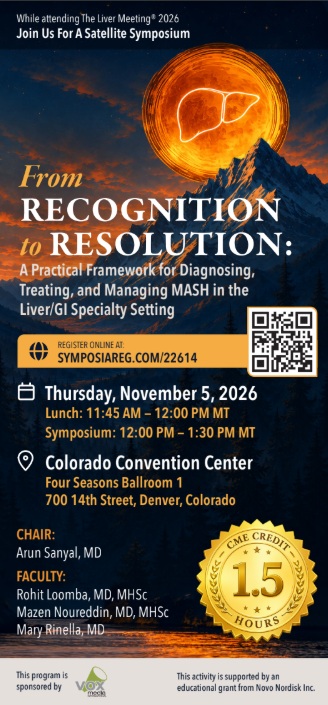
From Recognition to Resolution: A Practical Framework for Diagnosing, Treating, and Managing MASH in the Liver/GI Specialty Setting
Thursday November 5, 2026
Lunch & Symposium: 12 pm to 1:30 pm MT
Colorado Convention Center
Four Seasons Ballroom 1
700 14th Street
Denver, Colorado
Program Overview:
Metabolic dysfunction-associated steatohepatitis (MASH) is the progressive, inflammatory form of metabolic dysfunction-associated steatotic liver disease (MASLD) and one of the most rapidly growing causes of end-stage liver disease in the United States. An estimated 14.9 million Americans had MASH in 2020; that figure is projected to reach 23.2 million by 2050. Despite this burden, real-world clinical records capture MASH prevalence at only 0.15% of adults, indicating the vast majority of patients remain unidentified and untreated. The MASH therapeutic landscape has transformed substantially with two FDA approvals in 18 months: resmetirom and semaglutide 2.4 mg/week, both indicated for non-cirrhotic MASH with significant fibrosis. Agent selection requires an understanding of their distinct mechanisms, metabolic effects, comorbidity considerations, monitoring requirements and tolerability differences. Additionally, the non-invasive testing (NIT) frameworks that determine which patients qualify for treatment have been substantially updated by AASLD’s 2025 practice guidelines on blood-based and imaging-based assessment — replacing earlier guidance and requiring integration into clinical workflow. For patients with compensated MASH cirrhosis the fibroblast growth factor 21 (FGF21) analog class represents the most clinically advanced area of investigational research, with ongoing Phase 3 programs in both pre-cirrhotic MASH and compensated cirrhosis. This program is specifically designed for the liver/GI specialty audience: hepatologists, gastroenterologists, and advanced practice providers who manage patients with MASH and are positioned to implement the updated NIT framework, initiate approved pharmacotherapy, and counsel patients on emerging options.
Educational Objectives:
Upon completion of this activity, participants should be able to:
- Apply the AASLD-endorsed stepwise non-invasive testing framework — including FIB-4, VCTE/ELF, and MRE — to identify patients with MASH and significant fibrosis (F2–F3) who are candidates for pharmacotherapy, and describe the role of liver biopsy in cases of diagnostic uncertainty
- Compare the mechanism of action, Phase 3 clinical evidence, patient selection criteria, and monitoring requirements for resmetirom and semaglutide 2.4 mg/week in patients with non-cirrhotic MASH and F2–F3 fibrosis, and apply this comparison to individualized treatment decisions based on patient comorbidity profile
- Characterize the FGF21 analog class — including efruxifermin and pegozafermin — by mechanism of action, Phase 2 and Phase 3 evidence to date, and current regulatory status, and describe the evidence supporting the investigational role of FGF21 analogs in patients with pre-cirrhotic MASH and compensated cirrhosis due to MASH
- Formulate an evidence-based management plan for patients with compensated MASH cirrhosis, including surveillance priorities, appropriate use of approved therapies for comorbid conditions, and accurate patient communication regarding investigational treatment options