
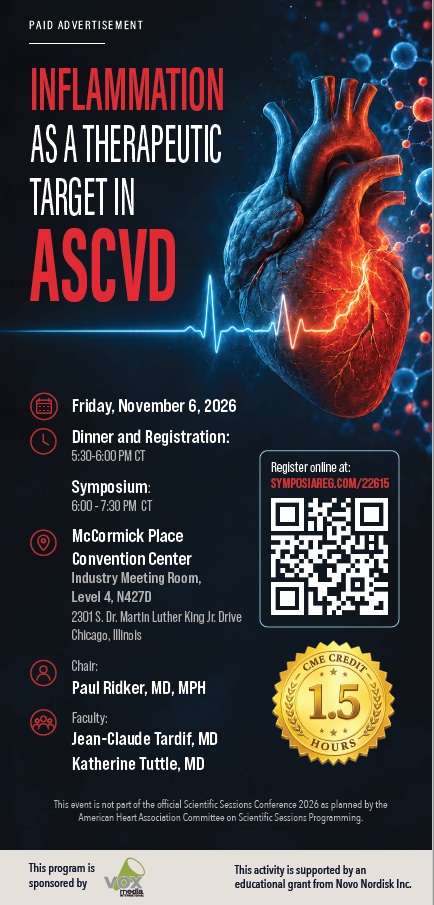
Pre-registration for:
Inflammation as a Therapeutic Target in ASCVD
Friday, November 6, 2026
Dinner and Registration: 5:30pm - 6:00pm CT
Symposium: 6:00pm - 7:30pm CT
McCormick Place Convention Center
Industry Meeting Room, Level 4, N27D
2301 S. Dr. Martin Luther King Jr. Drive
Chicago, Illinois
Program Overview:
Atherosclerotic cardiovascular disease (ASCVD) remains the leading cause of cardiovascular morbidity and mortality globally, affecting approximately 26 million Americans and responsible for roughly 400,000 deaths annually. Despite the transformative impact of statin therapy on secondary prevention, recurrent cardiovascular events remain common even in well-treated patients on high-intensity statin regimens. The persistence of this residual risk reflects multiple pathophysiological mechanisms beyond LDL-cholesterol — foremost among them, cardiovascular (CV) inflammation, now established as a clinically measurable, independent, and modifiable contributor to atherosclerotic disease. The 2025 ACC Scientific Statement on Inflammation and Cardiovascular Disease represents the field’s definitive synthesis of this evidence and underscores the urgent need for cardiologists to operationalize inflammatory risk screening and treatment in clinical practice. In addition to ASCVD, chronic inflammation has not only been identified as a central mediator in the pathological progression of cardiovascular-kidney-metabolic (CKM) syndrome but also as a pivotal molecular hub that drives coordinated damage across multiple organ systems.
The clinical evidence for CV inflammation as a therapeutic target has expanded substantially over the past decade. The CANTOS trial demonstrated that targeting the IL-1?gIL-6gCRP inflammatory pathway reduces cardiovascular events independently of lipid effects. Subsequent randomized trials of low-dose colchicine — COLCOT and LoDoCo2 — demonstrated that this orally available anti-inflammatory agent reduces MACE by 25–31% in secondary prevention populations, leading to FDA approval of low-dose colchicine for cardiovascular risk reduction. Despite this approval, adoption remains limited; high-sensitivity C-reactive protein (hsCRP) is not systematically measured across cardiology practices, and colchicine is substantially underprescribed. Low-dose colchicine, however, has a number of drug-drug interactions and is contraindicated among individuals with chronic kidney disease (CKD); therefore, there is an unmet clinical need for additional safe and effective anti-inflammatory approaches in the setting of CKD. Clinicians have had limited exposure to education specifically addressing inflammatory risk identification and management. Therefore, in this symposium, experts will provide attendees with a comprehensive review of the therapeutic landscape and equip the audience with a practical framework for identifying and managing residual CV inflammatory risk in their patients.
Educational Objectives:
Upon completion of this activity, participants should be able to:
- Describe the role of the IL-1?gIL-6gCRP inflammatory pathway in atherosclerotic plaque progression and rupture, and explain the clinical evidence supporting hsCRP as an independent predictor of recurrent MACE in statin-treated patients with ASCVD
- Identify patients across cardiology subspecialties with established ASCVD and residual inflammatory risk, and apply a structured hsCRP screening and interpretation framework to clinical decision-making
- Discuss the mechanism, clinical outcomes evidence, safety profile, and appropriate patient selection for low-dose colchicine as the current standard of evidence-based anti-inflammatory secondary prevention
- Recognize that inflammation is not only a central mediator in the pathological progression of CKM syndrome but also a pivotal molecular hub that drives coordinated damage across multiple organ systems